
For some couples, pregnancy may not be possible or may be difficult using their own eggs or sperm. Conditions such as very low ovarian reserve, premature ovarian insufficiency, severe male-factor infertility, repeated IVF failures or certain genetic conditions may lead a fertility specialist to discuss donor-assisted reproduction.
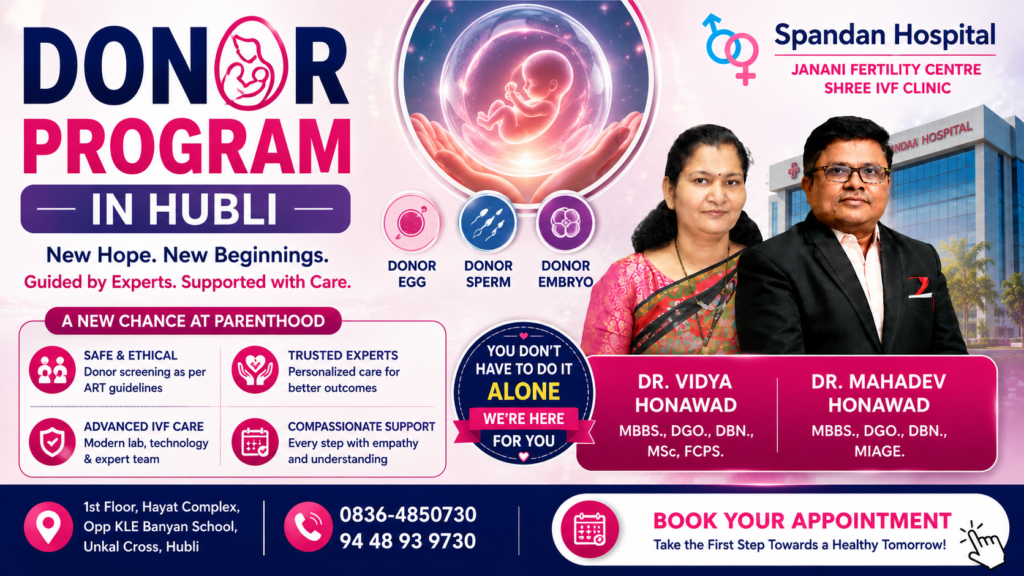
For couples looking for a Donor Program in Hubli, Spandan Hospital & Janani Fertility Centre provides fertility evaluation and assisted reproductive treatment under the guidance of experienced fertility specialists. The centre is associated with Dr. Vidya Honawad and Dr. Mahadev Honawad, who specialise in obstetrics, gynaecology and infertility treatment.
Donor-assisted treatment may involve donor eggs, donor sperm or donor embryos, depending on the medical condition and treatment requirements of the intended parents. Available information about Spandan Hospital & Janani Fertility Centre lists donor sperm, donor egg and donor embryo services among its fertility services.
What is a Donor Program?
A donor program is an assisted reproductive treatment option in which reproductive material from an eligible donor is used to help an individual or couple achieve pregnancy.
Depending on the fertility problem, treatment may involve:
- Donor eggs
- Donor sperm
- Donor embryos
The decision to use donor material should be made after a detailed fertility evaluation and counselling with a qualified fertility specialist.
Why is Donor Treatment Needed?
Donor treatment may be considered when using the patient’s own eggs or sperm is not suitable or is unlikely to provide an appropriate treatment option.
Some situations where donor treatment may be discussed include:
- Very low ovarian reserve
- Premature ovarian insufficiency
- Poor egg quality
- Advanced reproductive age
- Repeated IVF failures associated with egg quality
- Severe male-factor infertility
- Azoospermia
- Certain genetic or hereditary conditions
- Failure to obtain usable sperm
- Certain fertility conditions where donor gametes may provide an alternative
However, donor treatment is not required for every infertility patient. A fertility specialist first evaluates the underlying cause of infertility and discusses available treatment options.

Types of Donor Programs in Hubli
1. Donor Egg Program
A donor egg program uses eggs obtained from an eligible donor for fertility treatment.
The donor eggs are fertilised with sperm according to the recommended IVF/ICSI treatment plan. The resulting embryo may then be transferred into the recipient’s uterus.
Donor egg treatment may be considered when a woman has:
- Very low ovarian reserve
- Premature ovarian insufficiency
- Significantly reduced egg quality
- Certain genetic conditions
- Repeated IVF failures related to egg quality
- Other medically indicated conditions affecting the availability or quality of her own eggs
The suitability of donor egg IVF is decided after individual fertility assessment.
2. Donor Sperm Program
Donor sperm treatment may be considered when the male partner has severe sperm-related infertility or when usable sperm cannot be obtained despite appropriate evaluation.
Depending on the clinical situation, donor sperm may be used for:
- IUI
- IVF
- Other appropriate assisted reproductive procedures
Before donor sperm treatment, the male partner’s fertility should be properly evaluated to understand whether donor sperm is actually required.
3. Donor Embryo Program
A donor embryo program involves the transfer of an embryo created using donor reproductive material.
This option may be discussed in selected situations where using the couple’s own eggs and sperm is not appropriate.
The fertility specialist will evaluate the medical, reproductive and regulatory considerations before recommending this treatment.
Who May Benefit From a Donor Egg Program?
Donor egg IVF may be considered for women with certain fertility conditions, including:
Low Ovarian Reserve
When ovarian reserve is significantly reduced, obtaining suitable eggs during an IVF cycle may become difficult.
Premature Ovarian Insufficiency
Premature ovarian insufficiency can reduce the availability of eggs and may make pregnancy using one’s own eggs difficult in some cases.
Poor Egg Quality
Egg quality can decline with reproductive age and may affect fertilisation, embryo development and fertility treatment outcomes.
Repeated IVF Failure
If previous IVF cycles have repeatedly failed and egg-related factors are suspected, donor eggs may be discussed as one possible treatment option.
Genetic Concerns
In selected cases involving a significant risk of passing on a genetic condition, donor eggs may be considered after appropriate medical and genetic counselling.
Who May Need Donor Sperm?
Donor sperm may be considered in selected cases such as:
- Severe male-factor infertility
- Azoospermia
- Certain genetic conditions
- Failure to obtain usable sperm
- Certain situations where the use of partner sperm is not medically appropriate
A complete male fertility evaluation should generally be performed before moving toward donor sperm treatment.
How Does Donor Egg IVF Work?
A donor egg IVF treatment cycle generally involves several stages.
Step 1: Fertility Consultation
The recipient undergoes a detailed fertility evaluation. The doctor reviews medical history, previous fertility treatments, investigations and reproductive goals.
Step 2: Donor Selection and Screening
Donor gametes must be sourced through the appropriate ART framework. Donor screening is performed according to applicable medical and regulatory requirements.
Under India’s ART Act, screening of gamete donors and the collection, screening and storage of semen, as well as provision of oocyte donors, are functions assigned to registered ART banks. The Act also specifies donor age ranges and disease screening requirements.
Step 3: Preparation of the Recipient
The recipient’s uterus is prepared according to the fertility specialist’s recommended treatment protocol.
Step 4: Egg Retrieval and Fertilisation
The donor undergoes egg retrieval under medical supervision. The retrieved eggs are fertilised using the sperm recommended as part of the treatment plan.
Step 5: Embryo Development
The resulting embryos are monitored in the embryology laboratory.
Step 6: Embryo Transfer
A suitable embryo is transferred into the recipient’s uterus according to the treatment plan.
Step 7: Pregnancy Test
A blood pregnancy test is performed after the recommended interval following embryo transfer.
Read More : Embryo Freezing in Hubli Advanced Embryo Cryopreservation at Spandan Hospital
How Does Donor Sperm Treatment Work?
The treatment depends on whether IUI or IVF is recommended.
For donor sperm IUI, the general process may include:
- Monitoring the woman’s menstrual cycle.
- Tracking or medically supporting ovulation when appropriate.
- Obtaining screened donor sperm through the appropriate ART bank.
- Preparing the sperm sample.
- Placing the prepared sperm into the uterus using a thin catheter.
- Performing a pregnancy test after the recommended interval.
For IVF, donor sperm may be used to fertilise retrieved eggs, followed by embryo culture and embryo transfer.
How Are Donors Screened?
Donor screening is an important part of donor-assisted reproduction.
Under the ART (Regulation) Act, 2021, donor gamete screening and sourcing are regulated through registered ART banks. The Act specifies that sperm donors are obtained within the prescribed age range of 21–55 years and oocyte donors within 23–35 years, with donors examined for prescribed diseases.
Depending on the applicable requirements, donor assessment may involve:
- Medical history
- Family history
- Infectious disease screening
- Relevant genetic assessment
- Physical health assessment
- Reproductive health evaluation
- Other prescribed investigations
The exact screening process may depend on the type of donation and current regulations.
Is Donor Treatment Legal in India?
Yes. Donor-assisted reproductive treatment is regulated under the Assisted Reproductive Technology (Regulation) Act, 2021.
The Act provides a legal framework for regulating ART clinics and ART banks and aims to promote safe and ethical ART practices.
The Act also requires ART clinics to obtain donor gametes from ART banks and ensure that donors have undergone the required medical testing. Clinics must provide professional counselling about the treatment, including its implications, chances of success, advantages, disadvantages, costs and risks.
Is Donor Information Confidential?
Confidentiality is an important part of donor-assisted reproduction.
The ART Act requires clinics and ART banks to maintain confidentiality regarding information about the commissioning couple, woman and donor, subject to the circumstances specified by law.
Patients should discuss donor-related information, documentation, consent and confidentiality with their fertility specialist before beginning treatment.
Written Consent for Donor Treatment
Donor-assisted fertility treatment involves important consent requirements.
The ART Act requires written informed consent before ART treatment. It also contains specific requirements relating to the cryopreservation and use of human gametes and embryos.
Your fertility centre should explain the treatment process, relevant documentation and consent requirements before starting treatment.
Benefits of Donor Programs
For appropriately selected patients, donor-assisted reproduction can provide an additional pathway toward pregnancy.
Potential benefits include:
- An option when own eggs or sperm are not suitable
- Access to appropriately screened donor gametes
- An alternative after certain unsuccessful fertility treatments
- An option in selected genetic conditions
- Personalised fertility treatment planning
- Professional medical and counselling support
However, donor treatment does not guarantee pregnancy, and outcomes vary between individuals.
Donor Program and IVF Treatment
Donor treatment is often combined with IVF or other assisted reproductive techniques.
For example:
Donor Egg + Partner Sperm → IVF/ICSI → Embryo Development → Embryo Transfer
or
Patient’s Egg + Donor Sperm → IUI/IVF → Pregnancy
The treatment approach depends on the fertility diagnosis and the recommendation of the fertility specialist.
Why Choose Spandan Hospital & Janani Fertility Centre in Hubli?
Spandan Hospital Janani Fertility Centre Shree IVF Clinic , Hubli provides fertility and gynaecological services in Hubli.
The centre’s official profile lists Dr. Vidya Mahadev Honawad as an Obstetrician, Gynaecologist and Fertility Treatment Specialist with experience in IVF/ICSI and difficult fertility problems. It also lists Dr. Mahadev Honawad as an Obstetrician, Gynaecologist and Hystero-Laparoscopic Surgeon.
Dr. Vidya Mahadev Honawad
MBBS, MS, DNB, DGO, FCPS
Dr. Vidya Honawad is described by the centre as an Obstetrician, Gynaecologist and Fertility Treatment Specialist. Her professional profile includes a Fellowship in Reproductive Medicine.
Dr. Mahadev Honawad
MBBS, DGO, DNB, MIAGE
Dr. Mahadev Honawad is described by the centre as an Obstetrician, Gynaecologist and Hystero-Laparoscopic Surgeon, with a Fellowship in Advanced Hystero-Laparoscopy.
The centre also states that it has a Class 10,000 IVF laboratory and facilities for advanced hystero-laparoscopic surgeries.
What Should You Ask Before Starting a Donor Program?
Before beginning treatment, couples should understand:
- Why donor treatment is being recommended
- Whether donor egg, donor sperm or donor embryo is appropriate
- Whether IUI or IVF/ICSI is required
- How donor screening is performed
- What donor information can legally be provided
- What medical investigations are required
- What consent documents are needed
- What the treatment timeline will be
- What the estimated treatment cost is
- What alternative treatment options are available
Taking time to understand these points can help couples make an informed decision.
Donor Program in Hubli – A Personalised Approach
Every infertility case is different. Donor treatment should therefore be considered only after proper evaluation of both partners.
At Spandan Hospital & Janani Fertility Centre, couples can discuss their fertility history and treatment options with the specialist team. Depending on the diagnosis, the fertility team may discuss IVF, ICSI, donor egg, donor sperm, donor embryo or other appropriate fertility treatment options.
The goal is to identify the treatment approach that is medically appropriate for the individual patient or couple.
Frequently Asked Questions
What is a donor program in IVF?
A donor program is a fertility treatment in which donor eggs, donor sperm or donor embryos are used to help achieve pregnancy when using the patient’s own reproductive material is not suitable.
Is donor egg IVF available in Hubli?
Donor egg services are listed among the fertility services associated with Spandan Hospital & Janani Fertility Centre in Hubli.
When is donor egg treatment recommended?
It may be considered in selected cases involving very low ovarian reserve, premature ovarian insufficiency, poor egg quality, certain genetic conditions or repeated IVF failures related to egg factors.
When is donor sperm recommended?
Donor sperm may be considered for selected cases of severe male-factor infertility, azoospermia, certain genetic conditions or when usable sperm cannot be obtained.
Is donor treatment guaranteed to result in pregnancy?
No. Donor-assisted treatment can provide an additional treatment option, but pregnancy is not guaranteed.
Is donor treatment regulated in India?
Yes. ART clinics, ART banks and donor gamete sourcing are regulated under India’s Assisted Reproductive Technology (Regulation) Act, 2021.
Should I consult a fertility specialist before choosing donor treatment?
Yes. A detailed fertility evaluation and counselling session can help determine whether donor treatment is appropriate and which option may be suitable.
Get Expert Guidance for Donor Program in Hubli
If you are looking for a Donor Program in Hubli, Spandan Hospital & Janani Fertility Centre offers fertility evaluation and assisted reproductive care under experienced fertility specialists.
Whether you are considering Donor Egg IVF, Donor Sperm Treatment or Donor Embryo Treatment, consult a fertility specialist to understand your options, eligibility, treatment process and applicable requirements.
Spandan Hospital & Janani Fertility Centre
1st Floor, Hayat Complex, PB Road, Unkal Cross, Hubli – 580031, Karnataka.
Appointment: 0836-2377730
Dr. Mahadev Honawad: +91 9448939730
Donor Program Hubli, Donor Egg Program Hubli, Donor Egg IVF Hubli, Donor Sperm Program Hubli, Donor Sperm IVF Hubli, Donor Embryo Program Hubli, Donor Embryo IVF Hubli, Donor IVF Treatment Hubli, IVF with Donor Eggs Hubli, Egg Donation Hubli, Sperm Donation Hubli, Embryo Donation Hubli, Fertility Treatment Hubli, IVF Centre Hubli, Fertility Centre Hubli, Infertility Treatment Hubli
Donor Program in Hubli – Complete Guide to Donor Egg, Sperm & Embryo Treatment
- What is a Donor Program?
- Why is Donor Treatment Needed?
- Types of Donor Programs in Hubli
- Donor Egg Program
- Donor Sperm Program
- Donor Embryo Program
- Who May Benefit From a Donor Egg Program?
- Who May Need Donor Sperm?
- How Does Donor Egg IVF Work?
- How Does Donor Sperm Treatment Work?
- How Are Donors Screened?
- Is Donor Treatment Legal in India?
- Is Donor Information Confidential?
- Written Consent for Donor Treatment
- Benefits of Donor Programs
- Donor Program and IVF Treatment
- Why Choose Spandan Hospital & Janani Fertility Centre in Hubli?
- Frequently Asked Questions
- Get Expert Guidance for Donor Program in Hubli