
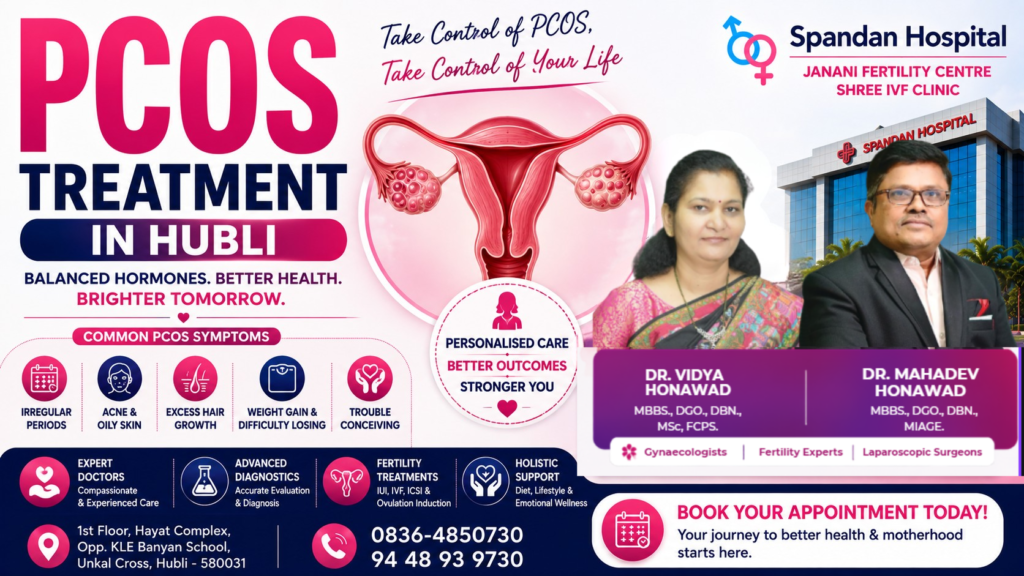
Polycystic Ovary Syndrome (PCOS) is a common hormonal and metabolic condition that can affect menstrual cycles, ovulation, fertility, skin and hair, body weight and long-term metabolic health.
Women with PCOS may experience irregular periods, difficulty with ovulation, acne, excess facial or body hair, weight-related concerns or difficulty conceiving. However, symptoms vary considerably from woman to woman.
For women looking for PCOS Treatment in Hubli, proper diagnosis and personalised treatment are important. PCOS management may include lifestyle measures, treatment for menstrual irregularity or androgen-related symptoms, fertility treatment when pregnancy is desired, and monitoring of metabolic health. The international 2023 guideline emphasises lifestyle, emotional wellbeing, quality of life and individualised medical care in PCOS.
What is PCOS?
PCOS stands for Polycystic Ovary Syndrome.
It is a hormonal condition that can affect ovarian function and ovulation. PCOS can also be associated with metabolic problems such as insulin resistance and an increased risk of conditions including type 2 diabetes.
Not every woman with PCOS has ovarian cysts, and seeing multiple follicles on an ultrasound does not by itself mean that a woman has PCOS.
Diagnosis requires assessment of the overall clinical picture rather than relying on ultrasound alone.
Common Symptoms of PCOS
PCOS symptoms can vary from one woman to another.
Common symptoms may include:
- Irregular menstrual periods
- Delayed or absent periods
- Difficulty with ovulation
- Difficulty conceiving
- Excess facial or body hair
- Acne
- Hair thinning or hair loss
- Weight gain or difficulty managing weight
- Darkening of skin in some areas
- Symptoms associated with insulin resistance
Some women may have only a few symptoms, while others may experience several.

What Causes PCOS?
There is no single cause of PCOS.
Several factors may contribute, including:
- Genetic factors
- Hormonal imbalance
- Insulin resistance
- Increased androgen activity
- Lifestyle and environmental factors
PCOS is a complex condition and its presentation can be different in different women. The 2023 international guideline describes PCOS as a condition with reproductive, metabolic and psychological features.
Does PCOS Mean There Are Cysts in the Ovaries?
Not necessarily.
The name Polycystic Ovary Syndrome can sometimes cause confusion.
A woman can have PCOS without having typical polycystic ovarian morphology, and ovarian morphology is only one part of the diagnostic assessment.
In adults, the 2023 guideline allows anti-Müllerian hormone (AMH) to be used as an alternative to ultrasound for assessing polycystic ovarian morphology in the appropriate diagnostic context.
Therefore, an ultrasound report alone should not be used to diagnose PCOS.
How is PCOS Diagnosed?
PCOS diagnosis requires a detailed evaluation.
The doctor may review:
- Menstrual history
- Ovulation pattern
- Symptoms of increased androgen activity
- Medical history
- Family history
- Physical examination
- Hormonal investigations
- Ultrasound when required
- Other investigations to rule out alternative causes
The diagnostic criteria are designed to identify the characteristic features of PCOS while excluding other conditions that can cause similar symptoms.
PCOS and Irregular Periods
Irregular periods are one of the common features of PCOS.
When ovulation does not occur regularly, menstrual cycles may become longer or periods may be missed.
Treatment depends on whether the woman is trying to conceive.
For women who are not currently planning pregnancy, treatment may focus on regulating periods and managing symptoms.
For women who want to become pregnant, treatment focuses on improving ovulation and achieving pregnancy.
PCOS and Infertility
PCOS is one of the common causes of ovulatory infertility.
Irregular or absent ovulation can make it difficult for an egg to be released regularly.
However, having PCOS does not mean that pregnancy is impossible.
Many women with PCOS can conceive naturally or with appropriate fertility treatment.
PCOS Treatment When Pregnancy is Not Planned
Treatment is based on the woman’s symptoms and health priorities.
Depending on the individual case, treatment may include:
- Lifestyle management
- Treatment for irregular menstrual cycles
- Management of acne or excess hair
- Management of metabolic risk factors
- Hormonal treatment when appropriate
Combined oral contraceptive pills are recommended as a first-line pharmacological option for menstrual irregularity and hyperandrogenism in appropriate women, according to the 2023 international guideline.
The appropriate medicine should be selected by a doctor after evaluating the patient’s health and treatment goals.
PCOS Treatment for Women Trying to Conceive
If a woman with PCOS is trying to become pregnant, treatment focuses on restoring or inducing ovulation and addressing any additional infertility factors.
The treatment may include:
- Lifestyle optimisation
- Ovulation induction
- Timed intercourse
- IUI in selected cases
- IVF when indicated
The 2023 international guideline recommends letrozole as the preferred first-line pharmacological treatment for ovulation induction in women with PCOS-related anovulatory infertility when there are no other infertility factors.
Medication should only be taken under the supervision of a qualified fertility specialist.
PCOS and Letrozole Treatment
Letrozole is an ovulation-induction medicine that may be recommended for women with PCOS who are not ovulating regularly and are trying to conceive.
It works by helping stimulate the hormonal signals responsible for follicular development and ovulation.
According to the international PCOS guideline, letrozole is the preferred first-line pharmacological treatment for ovulation induction in appropriately selected women with PCOS-related anovulatory infertility and no other infertility factors.
PCOS and Metformin
Metformin is a medicine that can be useful in selected women with PCOS, particularly when metabolic features such as insulin resistance are a concern.
It may also have a role in some women with PCOS-related anovulatory infertility.
However, metformin is not automatically required for every woman with PCOS.
The 2023 guideline states that metformin may be considered for metabolic features and can have a role in anovulatory infertility, while counselling patients that more effective ovulation-induction options may be available.
PCOS and Lifestyle Management
Lifestyle management is an important part of PCOS care.
It may include:
- Regular physical activity
- Balanced nutrition
- Adequate sleep
- Maintaining a healthy lifestyle
- Preventing excessive weight gain
- Managing stress
- Following an individualised treatment plan
Importantly, there is no single diet or exercise programme that has been shown to be universally superior for every woman with PCOS. The guideline recommends sustainable healthy lifestyle approaches tailored to the individual’s preferences and circumstances.
PCOS and Weight Management
Some women with PCOS may experience overweight or obesity, while PCOS can also occur in women who are not overweight.
Weight should therefore not be used as the only indicator of PCOS.
For women who need weight management, even preventing further weight gain and improving overall metabolic health can be important.
The 2023 guideline also emphasises avoiding weight stigma and providing respectful, individualised care.
PCOS and Diabetes Risk
PCOS can be associated with an increased risk of metabolic problems, including abnormal glucose regulation and type 2 diabetes.
Therefore, appropriate women with PCOS may require periodic assessment of metabolic health.
The international guideline recommends considering metabolic risk factors as part of ongoing PCOS management.
PCOS and Fertility Treatment
When lifestyle changes and first-line ovulation treatment do not result in pregnancy, other fertility treatments may be considered.
Depending on the individual situation, the fertility specialist may recommend:
Ovulation Induction
Medicines are used to stimulate ovulation.
IUI
Prepared sperm is placed directly into the uterus around the time of ovulation.
IVF
Eggs are retrieved and fertilised in the laboratory before embryo transfer.
The choice depends on age, ovarian reserve, ovulation, sperm parameters, fallopian tube status and previous treatment history.
IVF for PCOS
IVF may be considered when:
- Other ovulation treatments have not worked
- There are additional infertility factors
- Fallopian tube problems are present
- Significant male-factor infertility exists
- IVF is otherwise clinically indicated
The 2023 guideline considers IVF a later-line option for PCOS-related anovulatory infertility when other ovulation-induction treatments have failed and there is no separate absolute indication for IVF.
Women with PCOS undergoing fertility treatment also require careful medical monitoring because ovarian stimulation can carry a risk of excessive ovarian response.
PCOS and ICSI
ICSI may be used as part of IVF when there is an indication for assisted fertilisation, particularly when male-factor infertility or previous fertilisation problems are present.
PCOS by itself does not automatically mean that ICSI is required.
The fertilisation method should be selected according to the couple’s overall fertility evaluation.
Can PCOS Be Cured Permanently?
PCOS is generally considered a long-term condition rather than something that can be permanently cured with a single medicine.
However, its symptoms and associated health risks can often be managed effectively.
Treatment goals may change throughout life.
For example:
- Menstrual regulation may be the priority at one stage.
- Fertility treatment may become the priority when pregnancy is desired.
- Metabolic health may require ongoing monitoring.
- Symptoms such as acne or excess hair may need separate treatment.
This is why long-term, individualised PCOS care is important.
PCOS During Pregnancy
Women with PCOS who become pregnant may have a higher risk of certain pregnancy complications.
The 2023 international guideline identifies PCOS as a condition associated with increased pregnancy risks and recommends appropriate preconception counselling and pregnancy monitoring.
Women with PCOS who are planning pregnancy should therefore discuss their health and medications with their doctor before conception.
PCOS and Mental Health
PCOS can affect emotional wellbeing and quality of life.
Some women may experience:
- Anxiety
- Depression
- Body-image concerns
- Stress related to infertility
- Emotional difficulties related to symptoms
The international guideline recommends awareness and screening for psychological features in women with PCOS, with appropriate support or treatment when needed.
Why Choose Spandan Hospital & Janani Fertility Centre for PCOS Treatment in Hubli?
Spandan Hospital & Janani Fertility Centre, Hubli provides gynaecology and fertility care for women experiencing reproductive and fertility-related concerns.
The centre is associated with Dr. Vidya Mahadev Honawad and Dr. Mahadev Honawad, who provide obstetrics, gynaecology and fertility-related care.
Dr. Vidya Mahadev Honawad
MBBS, MS, DNB, DGO, FCPS
Dr. Vidya Honawad is an Obstetrician, Gynaecologist and Fertility Treatment Specialist. The centre’s professional information describes experience in fertility treatment including IVF/ICSI and management of difficult fertility problems.
Dr. Mahadev Honawad
MBBS, DGO, DNB, MIAGE
Dr. Mahadev Honawad is an Obstetrician, Gynaecologist and Hystero-Laparoscopic Surgeon, with expertise in hysteroscopic and laparoscopic procedures.
The centre also provides fertility treatment and assisted reproductive services.
What Should You Do If You Have PCOS?
If you have irregular periods, difficulty conceiving or other symptoms associated with PCOS, do not rely only on an ultrasound report.
A fertility or gynaecology specialist can evaluate:
- Menstrual cycles
- Ovulation
- Hormonal profile
- Ovarian function
- Metabolic health
- Fertility factors
- Other possible causes of irregular periods
Based on the evaluation, an individual treatment plan can be created.
Frequently Asked Questions About PCOS
What is PCOS?
PCOS is a common hormonal and metabolic condition that can affect ovulation, menstrual cycles, androgen-related symptoms, fertility and long-term health.
Can PCOS cause infertility?
Yes. PCOS can cause irregular or absent ovulation, which can make conception more difficult. However, many women with PCOS can become pregnant with appropriate treatment.
Can I get pregnant naturally with PCOS?
Yes. Some women with PCOS conceive naturally, while others may need ovulation induction or assisted reproductive treatment.
Is PCOS the same as ovarian cysts?
No. PCOS is a hormonal syndrome and is not simply the presence of ovarian cysts.
What is the first treatment for PCOS-related infertility?
For appropriately selected women with PCOS-related anovulatory infertility and no other infertility factors, the 2023 international guideline recommends letrozole as the preferred first-line pharmacological ovulation-induction treatment.
Is metformin necessary for every woman with PCOS?
No. Metformin may be useful for selected women, particularly when metabolic features are present. It should be prescribed based on individual medical assessment.
Does every woman with PCOS need IVF?
No. IVF is not automatically required. Many women can be treated with lifestyle management and ovulation-induction treatment, depending on their individual fertility factors.
Can PCOS be permanently cured?
PCOS is generally a long-term condition, but symptoms and associated risks can often be effectively managed with appropriate treatment and follow-up.
PCOS Treatment in Hubli
If you are searching for PCOS Treatment in Hubli, the first step is a proper medical evaluation.
At Spandan Hospital & Janani Fertility Centre, women can consult fertility and gynaecology specialists to understand their symptoms, menstrual irregularities, ovulation problems and fertility concerns.
Whether you need PCOS management, ovulation induction, IUI, IVF or another fertility treatment, the treatment should be selected according to your individual condition and reproductive goals.
Spandan Hospital & Janani Fertility Centre
1st Floor, Hayat Complex, Opp. KLE Banyan School, Unkal Cross, Hubli, Karnataka.
Appointment: 0836-4850730
Mobile: 94 48 93 9730