
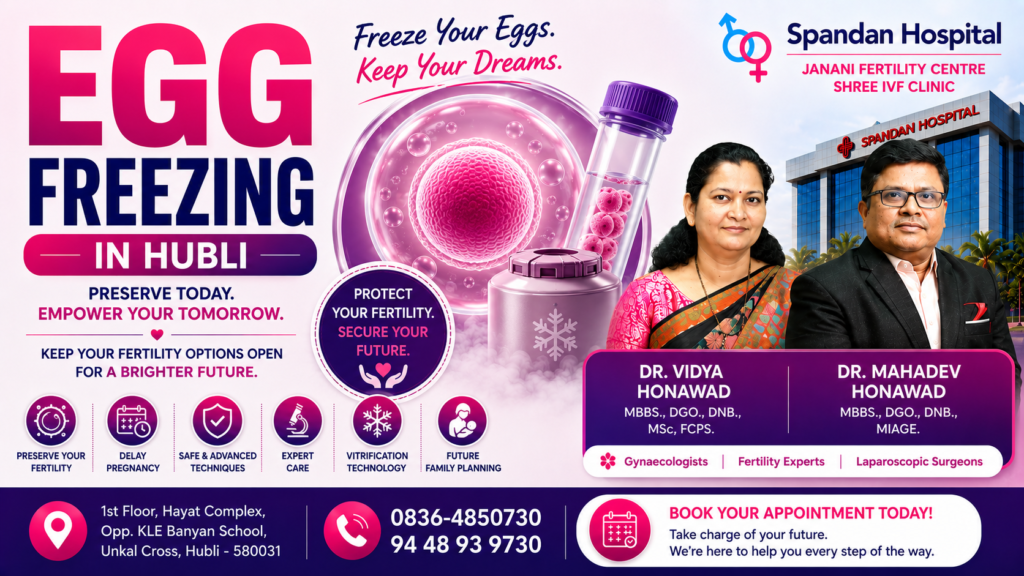
Egg Freezing in Hubli Egg freezing, also known as oocyte cryopreservation, is a fertility preservation technique in which a woman’s mature eggs are collected from the ovaries and frozen for possible use in the future.
Egg freezing can be considered by women who want to preserve their reproductive options for later, as well as women who may undergo medical treatments that could affect ovarian function.
For women searching for Egg Freezing in Hubli, a fertility specialist can assess age, ovarian reserve, reproductive health and future pregnancy plans before recommending whether egg freezing is appropriate.
At Spandan Hospital & Janani Fertility Centre, Hubli, fertility services are provided by Dr. Vidya Mahadev Honawad and Dr. Mahadev Honawad. The centre’s official profile lists fertility services, IVF/ICSI experience and advanced hystero-laparoscopic facilities.
What is Egg Freezing?
Egg freezing is a method of preserving unfertilised eggs for potential future use.
The process generally involves:
Ovarian stimulation → Egg retrieval → Egg freezing → Storage → Future thawing → Fertilisation → Embryo transfer
When a woman decides to use her frozen eggs, the eggs are thawed and typically fertilised using ICSI to create embryos. Suitable embryos can then be transferred into the uterus.
Why Do Women Consider Egg Freezing?
There can be several reasons for considering egg freezing.
1. Delaying Pregnancy
Some women may not be ready to start a family at their current stage of life.
Egg freezing may allow them to preserve eggs at a younger age for possible future use.
2. Medical Reasons
Certain medical treatments can affect ovarian function.
Women who are planning treatments such as chemotherapy that may affect fertility may discuss fertility preservation before treatment begins, whenever medically possible.
3. Fertility Preservation
Egg freezing can be considered as one option for preserving reproductive potential.
However, it is important to understand that freezing eggs does not guarantee a future pregnancy or baby.
How Does Egg Freezing Work?
Egg freezing generally follows several steps.
Step 1: Fertility Assessment
Before starting treatment, the fertility specialist evaluates the woman’s reproductive health.
The evaluation may include:
- Medical history
- Menstrual history
- Pelvic ultrasound
- Antral follicle count
- AMH testing
- Hormonal investigations when required
- Assessment of ovarian reserve
These investigations help the doctor understand the expected ovarian response to stimulation.
Step 2: Ovarian Stimulation
Fertility medicines are prescribed to stimulate the ovaries.
Instead of developing just one dominant follicle during a natural cycle, the aim is to develop multiple follicles so that several mature eggs may potentially be retrieved.
The response is monitored using ultrasound and, when required, blood tests.
Step 3: Egg Retrieval
Once the follicles reach the appropriate stage, mature eggs are collected through an egg retrieval procedure.
The procedure is generally performed under appropriate sedation or anaesthesia.
The retrieved eggs are then assessed by the embryology team.
Step 4: Egg Freezing
Suitable mature eggs are frozen using a specialised cryopreservation technique.
Vitrification, a rapid-freezing technique, is widely used because it reduces the formation of damaging ice crystals within the egg. ASRM describes vitrification as the standard approach that has improved post-warming oocyte survival.
Step 5: Egg Storage
The frozen eggs are stored under controlled cryopreservation conditions.
When the woman decides to use them in the future, the eggs can potentially be thawed and used for fertility treatment.
Step 6: Future Use of Frozen Eggs
When the eggs are needed, they are thawed.
Eggs that survive the warming process can be fertilised with sperm, usually through ICSI (Intracytoplasmic Sperm Injection).
If embryos develop successfully, an appropriate embryo may be transferred into the uterus as part of an IVF treatment cycle.
Egg Freezing and Age
Age at the time of egg freezing is an important factor.
As women age, both the number and quality of eggs generally decline.
This means that eggs frozen at a younger age may have better potential than eggs frozen later in reproductive life.
However, there is no specific age at which egg freezing guarantees a future pregnancy.
The HFEA specifically notes that the patient’s age at the time of freezing and the number of eggs frozen are important factors affecting the chance of conception using frozen eggs.
Is There a Best Age for Egg Freezing?
There is no universal age that is ideal for every woman.
The decision depends on:
- Current age
- Ovarian reserve
- Family-building plans
- Medical history
- Future pregnancy plans
- Number of eggs that may potentially be retrieved
A fertility specialist can provide an individualised assessment rather than relying on age alone.
Egg Freezing and Ovarian Reserve
Ovarian reserve refers to the remaining quantity of eggs in the ovaries.
Tests such as:
- AMH
- Antral follicle count
- Ultrasound
can help estimate ovarian reserve.
However, ovarian reserve tests primarily help predict the likely response to ovarian stimulation and egg yield; they should not be interpreted as a standalone guarantee of future live birth after egg freezing. ASRM notes that there is insufficient evidence that ovarian reserve testing independently predicts live birth after planned oocyte cryopreservation.
How Many Eggs Should Be Frozen?
There is no single number of eggs that guarantees a future baby.
The number required depends on factors such as:
- Age at freezing
- Ovarian reserve
- Number of mature eggs obtained
- Egg quality
- Future sperm quality
- Embryo development
ASRM notes that evidence is insufficient to define one universal number of mature oocytes that guarantees a reasonable chance of live birth.
Therefore, your fertility specialist should discuss realistic expectations based on your individual circumstances.
Egg Freezing vs Embryo Freezing
| Egg Freezing | Embryo Freezing |
|---|---|
| Unfertilised eggs are frozen | Fertilised eggs that have developed into embryos are frozen |
| Sperm is not required at the time of freezing | Sperm is required to create embryos |
| Gives flexibility for future fertilisation | Embryos are already created |
| Eggs are fertilised when they are used | Embryos can potentially be transferred later |
Both are established fertility-preservation options, but the appropriate choice depends on individual circumstances.
Egg Freezing vs IVF
Egg freezing and IVF are related but are not the same treatment.
Egg Freezing
The primary purpose is fertility preservation.
IVF
The primary purpose is to achieve pregnancy through fertilisation of eggs in the laboratory followed by embryo transfer.
Egg freezing may eventually involve IVF when the frozen eggs are thawed and fertilised.
Egg Freezing and ICSI
When frozen eggs are used in the future, ICSI is commonly used to fertilise the thawed eggs.
During ICSI, a single sperm is injected directly into a mature egg.
If fertilisation and embryo development are successful, an embryo may be transferred into the uterus.
Who May Consider Egg Freezing?
Egg freezing may be discussed with women who:
- Want to delay childbearing
- Are not currently ready for pregnancy
- Want to preserve reproductive options
- Are planning potentially fertility-affecting medical treatment
- Have concerns about future fertility
- Are considering fertility preservation for personal or medical reasons
The suitability of egg freezing should be evaluated individually.
Egg Freezing Before Cancer Treatment
Some cancer treatments can affect ovarian function.
For women who may receive fertility-affecting chemotherapy or other treatments, fertility preservation should ideally be discussed before treatment starts, if medically feasible.
Depending on age and circumstances, egg or embryo freezing may be considered.
The priority remains appropriate cancer treatment, and fertility preservation should be coordinated with the oncology team so that necessary treatment is not unnecessarily delayed.
Is Egg Freezing Safe?
Egg freezing is an established fertility-preservation technique.
However, the ovarian stimulation and egg-retrieval process can have potential risks.
These may include:
- Abdominal discomfort
- Bloating
- Ovarian hyperstimulation syndrome
- Bleeding
- Infection
- Procedure-related complications
Serious complications are uncommon, but your fertility specialist should explain the risks before treatment.
Does Egg Freezing Guarantee Pregnancy?
No.
Egg freezing provides an opportunity to preserve reproductive potential, but it is not a guarantee of future pregnancy.
The outcome depends on several factors, including:
- Age when eggs were frozen
- Number of eggs frozen
- Egg survival after thawing
- Fertilisation
- Embryo development
- Uterine health
- Age and health at the time of future pregnancy
The HFEA specifically advises that egg freezing should not be viewed as a guarantee of having a baby in the future.
What Happens When You Want to Use Frozen Eggs?
The process generally involves:
Egg thawing → ICSI fertilisation → Embryo development → Embryo transfer → Pregnancy monitoring
The eggs are carefully warmed and assessed.
Those that survive are fertilised using sperm.
If an embryo develops successfully, the fertility specialist may plan an embryo transfer based on the condition of the uterus and the patient’s treatment plan.
Can Frozen Eggs Be Used After Many Years?
Frozen eggs can be stored for extended periods under appropriate cryopreservation conditions.
However, storage duration and legal requirements may vary according to applicable regulations and clinic policies.
More importantly, the patient’s age at the time of egg freezing remains an important factor in the potential outcome.
Factors That Affect Egg Freezing Success
Several factors can influence the eventual outcome.
Age at Egg Freezing
Younger age at freezing is generally associated with better egg quality.
Number of Mature Eggs
A greater number of mature eggs may provide more opportunities for future treatment, although there is no guaranteed number.
Egg Survival
Not every frozen egg necessarily survives the warming process.
Fertilisation
Eggs that survive warming need to be successfully fertilised.
Embryo Development
Not every fertilised egg develops into a suitable embryo.
Uterine Health
The uterus also plays an important role when an embryo is eventually transferred.
Egg Freezing for Women With Endometriosis
Women with endometriosis may sometimes discuss fertility preservation, particularly when ovarian reserve is a concern or ovarian surgery is being considered.
The decision should take into account:
- Age
- Ovarian reserve
- Endometrioma
- Severity of endometriosis
- Previous ovarian surgery
- Future pregnancy plans
A fertility specialist can help determine whether egg freezing may be appropriate.
Egg Freezing for Women With Low Ovarian Reserve
Women with reduced ovarian reserve may still discuss fertility preservation with a specialist.
However, the number of eggs that can be retrieved may be lower.
AMH and antral follicle count can help assess expected ovarian response, but they cannot guarantee the eventual success of using frozen eggs.
Why Choose Spandan Hospital & Janani Fertility Centre for Egg Freezing in Hubli?
Spandan Hospital & Janani Fertility Centre, Hubli provides fertility services and assisted reproductive care.
The centre’s official profile lists Dr. Vidya Mahadev Honawad and Dr. Mahadev Honawad and states that the centre provides fertility services and advanced hystero-laparoscopic surgeries.
Dr. Vidya Mahadev Honawad
MBBS, MS, DNB, DGO, FCPS
Dr. Vidya Honawad is an Obstetrician, Gynaecologist and Fertility Treatment Specialist. The centre’s official profile states that she has experience in fertility treatment including IVF/ICSI and managing difficult and complicated fertility cases. She has also completed a Fellowship in Reproductive Medicine.
Dr. Mahadev Honawad
MBBS, DGO, DNB, MIAGE
Dr. Mahadev Honawad is an Obstetrician, Gynaecologist and Hystero-Laparoscopic Surgeon. His listed expertise includes advanced hysteroscopic and laparoscopic procedures and fertility-enhancing surgeries. He has completed a Fellowship in Advanced Hystero-Laparoscopy.
What Should You Do Before Egg Freezing?
If you are considering egg freezing, consult a fertility specialist before making a decision.
Your doctor may evaluate:
- Age
- Ovarian reserve
- AMH
- Antral follicle count
- Menstrual history
- Previous medical history
- Previous ovarian surgery
- Fertility goals
- Planned medical treatments
The specialist can then explain the expected ovarian response, treatment process, potential risks and realistic expectations.
Frequently Asked Questions About Egg Freezing
What is egg freezing?
Egg freezing is a fertility-preservation technique in which mature eggs are collected and cryopreserved for potential future use.
Is egg freezing the same as embryo freezing?
No. Egg freezing stores unfertilised eggs, while embryo freezing stores embryos created after fertilisation.
What is vitrification?
Vitrification is a rapid freezing technique used to preserve eggs while minimising ice-crystal formation. It is now widely used for oocyte cryopreservation.
Does egg freezing guarantee a baby?
No. Egg freezing does not guarantee future pregnancy or live birth.
Does age matter in egg freezing?
Yes. Age at the time of freezing is an important factor because egg quantity and quality generally decline with age.
Can frozen eggs be used for IVF?
Yes. Frozen eggs can potentially be thawed, fertilised and developed into embryos for transfer.
Is ICSI used with frozen eggs?
ICSI is commonly used when thawed eggs are fertilised, because it involves directly injecting a sperm into the egg.
Can women with endometriosis freeze their eggs?
In selected cases, yes. The decision depends on age, ovarian reserve, endometriosis severity, ovarian involvement and fertility goals.
Can women with low AMH freeze eggs?
It may still be possible, but the expected number of eggs retrieved may be lower. A fertility specialist should assess ovarian reserve and provide individualised counselling.
Egg Freezing in Hubli
If you are searching for Egg Freezing in Hubli, an early consultation with a fertility specialist can help you understand whether fertility preservation is suitable for you.
At Spandan Hospital & Janani Fertility Centre, women can discuss fertility preservation, egg freezing, embryo freezing, IVF and ICSI based on their individual reproductive goals.
Egg freezing can provide an additional option for future family planning, but it should be approached with realistic expectations and proper medical counselling.
Spandan Hospital & Janani Fertility Centre
1st Floor, above Yamaha Showroom, PB Road, Unkal Cross, Hubli – 580031, Karnataka.
Appointment: 0836-2377730
Dr. Mahadev Honawad: +91 9448939730