
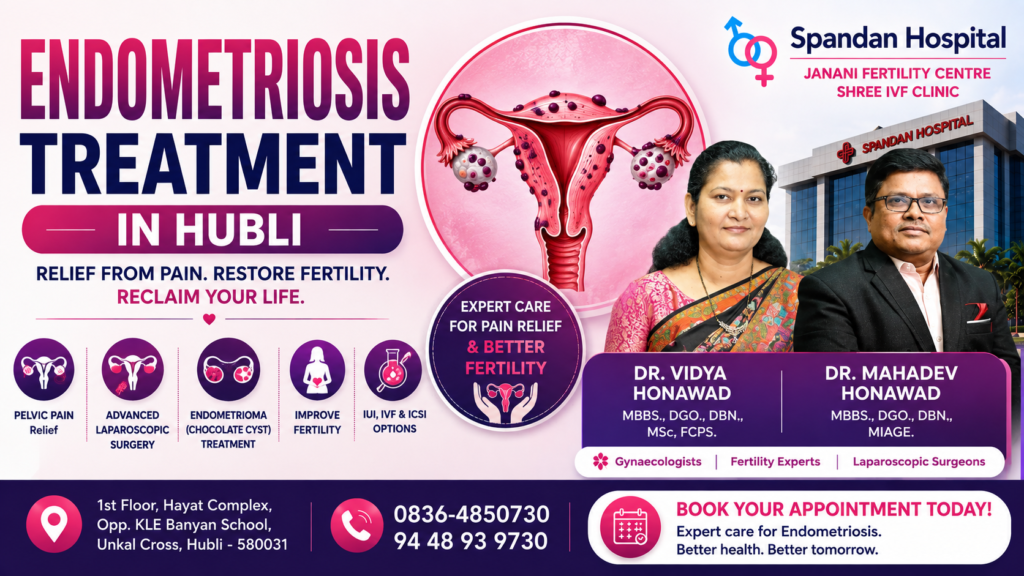
Endometriosis is a chronic gynaecological condition in which tissue similar to the lining of the uterus grows outside the uterus. It can cause pelvic pain, painful periods, pain during intercourse and, in some women, difficulty conceiving.
For women looking for Endometriosis Treatment in Hubli, early evaluation by a qualified gynaecologist or fertility specialist can help identify the condition and plan appropriate treatment.
At Spandan Hospital & Janani Fertility Centre, Hubli, fertility and gynaecological services are provided by Dr. Vidya Mahadev Honawad and Dr. Mahadev Honawad. The centre’s official profile lists fertility services and advanced hystero-laparoscopic surgeries, with Dr. Mahadev Honawad specifically experienced in endometriosis surgery.
What is Endometriosis?
Endometriosis is a condition in which endometrium-like tissue develops outside the normal uterine cavity.
These lesions can occur around:
- Ovaries
- Fallopian tubes
- Pelvic lining
- Uterus and surrounding tissues
- Other pelvic structures
The condition can cause inflammation and scar tissue or adhesions.
Endometriosis is commonly associated with pelvic pain and infertility, although some women may have minimal or no symptoms.
Common Symptoms of Endometriosis
Symptoms can vary significantly from one woman to another.
Common symptoms include:
- Severe period pain
- Chronic pelvic pain
- Pain during or after sexual intercourse
- Pain while passing stools during periods
- Pain while urinating during periods
- Heavy or irregular bleeding
- Bloating and fatigue
- Difficulty conceiving
- Pain that worsens around menstruation
Not every woman with endometriosis experiences all of these symptoms.
What Causes Endometriosis?
The exact cause of endometriosis is not completely understood.
Several biological and genetic factors may contribute to the development of the condition.
Because endometriosis can have different presentations, diagnosis should be based on the complete clinical picture rather than on one symptom or test alone.
Endometriosis and Infertility
Endometriosis can affect fertility in several ways.
It may be associated with:
- Pelvic inflammation
- Adhesions
- Changes around the ovaries and fallopian tubes
- Endometriomas
- Reduced ovarian reserve in some patients
- Changes in the pelvic environment
However, having endometriosis does not mean that pregnancy is impossible.
Some women with endometriosis conceive naturally, while others may require fertility treatment.
Types of Endometriosis
Endometriosis can occur in different forms.
Superficial Peritoneal Endometriosis
This involves endometriotic lesions on the surface of the pelvic peritoneum.
Ovarian Endometrioma
An ovarian endometrioma is an ovarian cyst associated with endometriosis. It is sometimes referred to as a “chocolate cyst” because of its characteristic thick, old-blood content.
Deep Endometriosis
Deep endometriosis involves lesions that extend deeper into pelvic tissues and may affect structures such as the bowel, bladder or other pelvic organs.
The location and extent of disease can influence symptoms and treatment planning.
How is Endometriosis Diagnosed?
Diagnosis usually begins with a detailed medical history and clinical evaluation.
The doctor may assess:
- Menstrual history
- Pain pattern
- Sexual pain
- Bowel or urinary symptoms
- Fertility history
- Previous surgeries
- Previous treatments
Ultrasound
Pelvic ultrasound can be useful in the evaluation of endometriosis, particularly for identifying ovarian endometriomas and some forms of deep endometriosis.
Current ESHRE guidance recommends imaging such as ultrasound or MRI in the diagnostic work-up, while also noting that a normal imaging result does not completely exclude endometriosis, particularly superficial disease.
MRI
MRI may be recommended in selected patients when deeper disease is suspected or when more detailed pelvic imaging is needed.
Laparoscopy
Laparoscopy is a minimally invasive surgical procedure that allows the doctor to directly inspect the pelvic organs.
In selected patients with suspected endometriosis, particularly when imaging is negative or empirical treatment has not been successful or is inappropriate, laparoscopy may be considered for diagnosis and treatment.
Is Surgery Always Required for Endometriosis?
No.
Treatment depends on:
- Severity of symptoms
- Age
- Fertility plans
- Location of endometriosis
- Ovarian reserve
- Previous surgeries
- Presence of endometrioma
- Other infertility factors
- Patient preferences
Some women may be managed medically, while others may benefit from surgery.
The decision should be individualised.
Endometriosis Treatment Options
Treatment can broadly include:
- Pain-relieving medicines
- Hormonal treatment
- Laparoscopic surgery
- Fertility treatment
- IVF/ICSI when appropriate
- Combination treatment
The primary goal may be pain control, fertility improvement, or both.
Medical Treatment for Endometriosis
Hormonal medicines can be used to suppress or regulate ovarian hormonal activity and help control endometriosis-associated pain.
Depending on the patient’s condition, the doctor may consider:
- Combined hormonal contraceptives
- Progestogen-based treatment
- Other hormonal therapies
- Pain-relieving medicines
Hormonal treatment is generally used to control symptoms rather than to improve fertility.
For women actively trying to conceive, ovarian-suppressing hormonal treatment should not be prescribed solely to improve fertility.
Laparoscopic Treatment for Endometriosis
Laparoscopy is a minimally invasive surgical approach that can be used to treat endometriotic lesions and adhesions in appropriately selected patients.
During laparoscopic surgery, the surgeon may:
- Identify endometriotic lesions
- Remove or treat endometriotic implants
- Release adhesions
- Treat selected ovarian endometriomas
- Assess pelvic anatomy
The exact procedure depends on the location and severity of endometriosis.
ESHRE guidance states that the decision to perform surgery should consider symptoms, age, fertility goals, previous surgery, other infertility factors, ovarian reserve and other fertility-related factors.
Endometrioma Treatment
An endometrioma is an ovarian cyst associated with endometriosis.
Not every endometrioma requires surgery.
The decision may depend on:
- Size of the cyst
- Pain symptoms
- Ovarian reserve
- Fertility plans
- Previous surgery
- Suspicion of other ovarian pathology
- Whether assisted reproduction is planned
Ovarian surgery needs careful consideration because surgery on the ovary can potentially affect ovarian reserve.
Endometriosis and Fertility Treatment
Women with endometriosis who are trying to conceive may require a fertility-focused treatment plan.
Depending on individual factors, options may include:
Natural Conception
Women with minimal disease and no other major infertility factors may be able to conceive naturally.
Ovulation Treatment
In selected patients, ovulation induction may be considered when there is an associated ovulation problem.
IUI
IUI may be considered for selected patients depending on age, ovarian reserve, tubal status, sperm parameters and severity of endometriosis.
IVF
IVF may be recommended when there are additional infertility factors, significant disease, reduced fertility potential or when other treatments are unsuccessful or unsuitable.
ESHRE guidance recognises surgery and/or medically assisted reproduction as options for managing endometriosis-associated infertility.
Endometriosis and IVF
IVF can help bypass some of the difficulties caused by pelvic endometriosis.
During IVF:
- Ovarian stimulation is performed.
- Eggs are retrieved.
- Eggs are fertilised in the laboratory.
- Embryos are developed.
- A suitable embryo is transferred into the uterus.
IVF may be considered depending on:
- Age
- Ovarian reserve
- Duration of infertility
- Endometriosis severity
- Previous surgery
- Sperm parameters
- Previous fertility treatment
The treatment plan should be individualised.
Endometriosis and ICSI
ICSI (Intracytoplasmic Sperm Injection) may be used as part of IVF when there is a specific indication, particularly related to sperm factors or previous fertilisation problems.
Endometriosis by itself does not automatically mean that ICSI is required.
The decision is made after evaluating both partners.
Does Endometriosis Surgery Improve Fertility?
The answer depends on the type and severity of endometriosis.
For some women with early-stage disease, operative laparoscopy may improve the chance of natural pregnancy. However, surgery is not automatically beneficial for every patient.
For ovarian endometriomas and deep endometriosis, the potential benefits and risks of surgery need to be carefully considered.
ESHRE specifically recommends that surgical decisions take into account ovarian reserve, fertility goals, age, symptoms and other infertility factors.
Endometriosis and Ovarian Reserve
Ovarian reserve is an important consideration in women with endometriosis, particularly when an ovarian endometrioma or previous ovarian surgery is present.
Tests such as:
- AMH
- Antral follicle count
- Other fertility assessments
may help the fertility specialist evaluate ovarian reserve.
Before ovarian surgery, women who are planning pregnancy may benefit from discussing the potential effect of surgery on ovarian reserve and fertility.
Can Endometriosis Come Back After Treatment?
Endometriosis can recur after treatment.
The risk of recurrence varies depending on several factors, including disease severity, treatment method and individual characteristics.
Long-term follow-up may therefore be recommended for women with significant endometriosis.
Treatment after surgery also depends on whether the woman is currently trying to conceive.
Endometriosis and Pregnancy
Many women with endometriosis can become pregnant.
However, some women may require fertility treatment.
Once pregnancy occurs, routine antenatal care and appropriate monitoring are important.
Women planning pregnancy after endometriosis treatment should discuss their fertility goals with their gynaecologist or fertility specialist.
Endometriosis and Pain Management
Pain management is an important part of endometriosis care.
Depending on the individual case, treatment may include:
- Pain-relieving medicines
- Hormonal treatment
- Surgery when indicated
- Lifestyle and supportive measures
- Multidisciplinary pain management in selected chronic cases
The treatment should focus on improving quality of life rather than treating an ultrasound finding alone.
Why Choose Spandan Hospital & Janani Fertility Centre for Endometriosis Treatment in Hubli?
Spandan Hospital & Janani Fertility Centre, Hubli provides gynaecology, fertility services and advanced hystero-laparoscopic surgical care.
Dr. Vidya Mahadev Honawad
MBBS, MS, DNB, DGO, FCPS
Dr. Vidya Honawad is an Obstetrician, Gynaecologist and Fertility Treatment Specialist. The centre’s official profile states that she has experience in fertility treatment including IVF/ICSI and management of difficult and complicated fertility problems. She has also completed a Fellowship in Reproductive Medicine.
Dr. Mahadev Honawad
MBBS, DGO, DNB, MIAGE
Dr. Mahadev Honawad is an Obstetrician, Gynaecologist and Hystero-Laparoscopic Surgeon.
According to the centre’s official profile, his surgical experience includes endometriosis surgery, ovarian cystectomy, fertility-enhancing hystero-laparoscopic surgeries, myomectomy and other advanced laparoscopic procedures. He has completed a Fellowship in Advanced Hystero-Laparoscopy.
The centre’s official profile lists its Hubli location at 1st Floor, above Yamaha Showroom, PB Road, Unkal, Hubli – 580031, Karnataka, with fertility services and advanced hystero-laparoscopic surgeries.
What Should You Do If You Suspect Endometriosis?
If you experience severe period pain, chronic pelvic pain, pain during intercourse or difficulty conceiving, consult a gynaecologist or fertility specialist.
Your doctor may recommend:
- Detailed medical history
- Pelvic examination
- Ultrasound
- MRI when required
- Fertility assessment
- Ovarian reserve testing
- Semen analysis for the partner
- Other investigations based on symptoms
A normal ultrasound does not always exclude endometriosis, so persistent symptoms should be discussed with a specialist.
Frequently Asked Questions About Endometriosis
What is endometriosis?
Endometriosis is a chronic condition in which tissue similar to the uterine lining grows outside the uterus and can cause pain, inflammation and fertility problems.
Can endometriosis cause infertility?
Yes. Endometriosis can be associated with infertility, but many women with endometriosis can conceive naturally or with appropriate fertility treatment.
Is endometriosis the same as an ovarian cyst?
No. An endometrioma is a type of ovarian cyst associated with endometriosis, but endometriosis can occur in other areas of the pelvis as well.
Does every woman with endometriosis need surgery?
No. Treatment depends on symptoms, disease location, age, ovarian reserve, fertility plans and other individual factors.
Can endometriosis be treated with medicines?
Yes. Hormonal and pain-relieving medicines may help control symptoms. However, hormonal suppression should not be used solely to improve fertility in women who are trying to conceive.
Can I get pregnant after endometriosis treatment?
Yes. Many women can conceive after treatment. Depending on the severity and other fertility factors, natural conception, IUI or IVF may be considered.
Can endometriosis come back?
Yes. Endometriosis can recur after treatment, so follow-up may be recommended.
Is laparoscopy useful for endometriosis?
Laparoscopy can be used to diagnose and treat suspected endometriosis in selected patients. It can also allow treatment of lesions and adhesions during the same procedure.
Endometriosis Treatment in Hubli
If you are searching for Endometriosis Treatment in Hubli, proper diagnosis and individualised treatment are important.
At Spandan Hospital & Janani Fertility Centre, patients can consult experienced gynaecology and fertility specialists for evaluation of endometriosis, pelvic pain, ovarian endometrioma and endometriosis-related infertility.
Depending on your condition, treatment may include medical management, laparoscopic surgery, fertility treatment, IUI, IVF or ICSI.
The right treatment should be decided after evaluating your symptoms, fertility goals, ovarian reserve and overall reproductive health.
Spandan Hospital & Janani Fertility Centre
1st Floor, Hayat Complex, above Yamaha Showroom, PB Road, Unkal, Hubli – 580031, Karnataka.
Appointment: 0836 2377730
Dr. Mahadev Honawad: +91 9448939730