
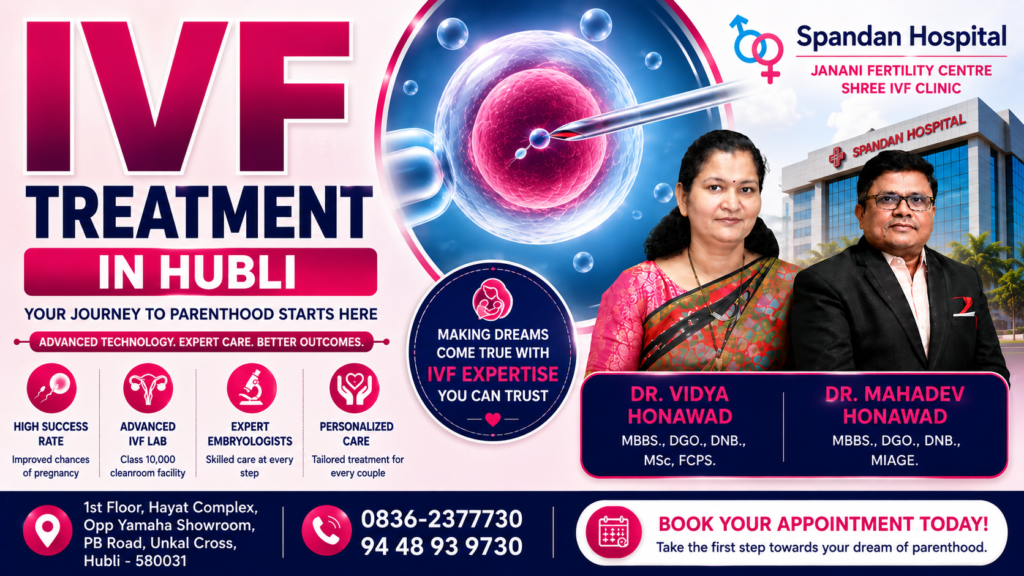
For couples who are having difficulty conceiving, IVF (In Vitro Fertilization) is one of the most advanced fertility treatments available today. IVF helps fertilisation take place in a laboratory, after which a suitable embryo is transferred into the woman’s uterus.
For couples looking for IVF Treatment in Hubli, Spandan Hospital Janani Fertility Centre Shree IVF Clinic provides fertility evaluation and assisted reproductive care under experienced fertility specialists.
The centre is associated with Dr. Vidya Mahadev Honawad and Dr. Mahadev Honawad, who specialise in obstetrics, gynaecology and infertility treatment. The centre’s official information also mentions IVF/ICSI fertility treatment and a Class 10,000 IVF laboratory.
What is IVF Treatment?
IVF stands for In Vitro Fertilization.
In IVF treatment, eggs are collected from the ovaries and fertilised with sperm in a specialised embryology laboratory. After fertilisation and embryo development, a suitable embryo is transferred into the uterus.
IVF can be considered for different causes of infertility, including problems related to the fallopian tubes, ovulation, sperm, endometriosis, ovarian reserve and unexplained infertility.
Who May Need IVF Treatment?
IVF may be recommended depending on the couple’s fertility evaluation.
Some common situations include:
- Blocked or damaged fallopian tubes
- Severe male-factor infertility
- Low sperm count or poor sperm motility
- Ovulation disorders
- Endometriosis
- Reduced ovarian reserve
- Repeated unsuccessful IUI cycles
- Unexplained infertility
- Certain genetic or reproductive conditions
- Previous fertility treatment failures
- Fertility preservation in selected cases
IVF is not automatically required for every infertility patient. A fertility specialist evaluates both partners before recommending treatment.

How Does IVF Treatment Work?
An IVF cycle generally involves several important steps.
Step 1: Fertility Evaluation
Before starting IVF, the fertility specialist evaluates both partners.
Depending on the case, investigations may include:
- Medical and fertility history
- Semen analysis
- Hormonal tests
- Ovarian reserve assessment
- Ultrasound
- Assessment of the uterus
- Fallopian tube evaluation when required
- Other specialised investigations
The purpose is to identify possible causes of infertility and develop an individual treatment plan.
Step 2: Ovarian Stimulation
Fertility medicines are prescribed to stimulate the ovaries to develop multiple follicles.
The patient’s response is monitored using ultrasound scans and, when required, blood tests.
The dosage and duration of medicines vary from patient to patient.
Step 3: Egg Retrieval
Once the follicles reach the appropriate stage of development, the eggs are collected through an egg retrieval procedure.
The procedure is generally performed under appropriate sedation or anaesthesia according to the clinical protocol.
Step 4: Fertilisation
The retrieved eggs are fertilised with sperm in the embryology laboratory.
Depending on the sperm quality and clinical situation, fertilisation may be performed using conventional IVF or ICSI (Intracytoplasmic Sperm Injection).
Step 5: Embryo Development
After fertilisation, the embryos are monitored in the laboratory.
Embryologists assess embryo development and determine which embryos are suitable for transfer or cryopreservation according to the treatment plan.
Step 6: Embryo Transfer
A suitable embryo is transferred into the uterus using a thin catheter.
The procedure is generally short and does not require an abdominal surgical incision.
Step 7: Pregnancy Test
A pregnancy test is performed after the recommended interval following embryo transfer.
If pregnancy occurs, further monitoring is carried out according to the fertility specialist’s advice.
IVF With ICSI
In some IVF cycles, ICSI may be recommended instead of conventional IVF.
ICSI involves directly injecting a selected sperm into a mature egg.
It may be considered particularly in selected cases of:
- Severe male-factor infertility
- Very low sperm count
- Poor sperm motility
- Previous fertilisation failure
- Surgically retrieved sperm
- Certain cases involving frozen eggs
The decision to use conventional IVF or ICSI depends on the individual patient’s fertility and laboratory findings.
IVF and Embryo Freezing
Not all suitable embryos necessarily need to be transferred during the same IVF cycle.
Depending on the treatment plan, suitable embryos may be frozen using modern cryopreservation techniques and stored for future use.
A later treatment cycle using a frozen embryo is known as Frozen Embryo Transfer (FET).
Embryo freezing may provide additional opportunities for pregnancy without repeating the entire ovarian stimulation and egg-retrieval process.
IVF for Male Infertility
Male-factor infertility can significantly affect natural conception.
Male infertility may be associated with:
- Low sperm count
- Poor sperm movement
- Abnormal sperm morphology
- Azoospermia
- Problems with sperm production
- Obstruction of the reproductive tract
- Certain medical or genetic conditions
Depending on the diagnosis, IVF with ICSI may be recommended.
In selected cases, sperm retrieval procedures may also be considered.
IVF for Female Infertility
Female fertility can be affected by several conditions.
IVF may be considered in selected cases involving:
- Reduced ovarian reserve
- Ovulation disorders
- Endometriosis
- Tubal problems
- Previous ovarian surgery
- Age-related fertility decline
- Repeated unsuccessful fertility treatments
A detailed evaluation is important to determine whether IVF is appropriate.
IVF for Blocked Fallopian Tubes
Fallopian tubes play an important role in natural fertilisation.
When both fallopian tubes are blocked or significantly damaged, sperm and egg may not be able to meet naturally.
In such situations, IVF can bypass the fallopian tubes because fertilisation occurs in the laboratory.
IVF for Endometriosis
Endometriosis can affect fertility in several ways.
Depending on the severity of endometriosis, age, ovarian reserve, previous treatment and fertility goals, a specialist may recommend medication, surgery, IUI, IVF or a combination of treatments.
IVF may be considered when endometriosis is associated with significant difficulty conceiving.
IVF for Unexplained Infertility
Sometimes fertility investigations do not identify a clear cause of infertility.
This is called unexplained infertility.
Depending on factors such as age, duration of infertility and previous treatment, the fertility specialist may recommend timed intercourse, ovulation induction, IUI or IVF.
What Are the Benefits of IVF?
For appropriately selected patients, IVF can offer several potential advantages:
- Bypasses blocked fallopian tubes
- Allows fertilisation to occur in a laboratory
- Can be combined with ICSI
- Allows embryos to be assessed before transfer
- Suitable embryos can be frozen for future treatment
- Can be used with donor eggs or sperm when medically appropriate
- Provides an option for several causes of infertility
However, IVF does not guarantee pregnancy.
IVF Success Rate
IVF outcomes vary considerably between individuals.
Several factors can influence the chances of pregnancy, including:
- Woman’s age
- Ovarian reserve
- Egg quality
- Sperm quality
- Embryo quality
- Uterine health
- Cause of infertility
- Previous fertility treatments
- Lifestyle and overall health
- Embryology laboratory factors
Therefore, there is no single IVF success rate that applies to every couple.
Your fertility specialist can provide a more personalised assessment after reviewing your medical history and investigations.
Is IVF Treatment Painful?
The IVF process involves several stages, and the experience can vary from patient to patient.
Ovarian stimulation involves fertility injections, while egg retrieval is performed using appropriate anaesthesia or sedation.
Embryo transfer is generally a short procedure and usually does not require major surgery.
The fertility team will explain each stage and provide instructions for medicines and recovery.
Possible Risks of IVF Treatment
IVF is generally performed under careful medical supervision, but it can have potential risks.
These may include:
- Ovarian hyperstimulation syndrome
- Discomfort or complications related to egg retrieval
- Infection or bleeding, although uncommon
- Multiple pregnancy depending on the number of embryos transferred
- Ectopic pregnancy
- Cycle cancellation in some situations
- Failure of fertilisation or embryo development
- Failure to achieve pregnancy
Your doctor will explain the potential benefits and risks before starting treatment.
IVF vs IUI
| IUI | IVF |
|---|---|
| Prepared sperm is placed directly into the uterus | Eggs are retrieved and fertilised in a laboratory |
| Fertilisation occurs inside the body | Fertilisation occurs outside the body |
| Less invasive | More advanced treatment |
| Usually simpler treatment | Requires ovarian stimulation and egg retrieval |
| Suitable for selected infertility cases | Used for a wider range of fertility problems |
The choice between IUI and IVF depends on age, diagnosis, fertility history and investigation results.
IVF vs ICSI
| IVF | ICSI |
|---|---|
| Eggs and sperm are combined in the laboratory | A single sperm is injected directly into the egg |
| Conventional fertilisation method | Micromanipulation technique |
| May be suitable when sperm parameters are adequate | Often considered for selected male-factor cases |
| Part of assisted reproductive treatment | Performed as part of an IVF cycle |
ICSI is not a replacement for IVF. It is a fertilisation technique that can be used within an IVF cycle when clinically appropriate.
Donor IVF Treatment
In some cases, a fertility specialist may discuss donor-assisted reproduction.
Depending on the medical situation, IVF may be performed using:
- Donor eggs
- Donor sperm
- Donor embryos
Donor treatment should be carried out according to applicable medical, ethical and legal requirements.
Why Choose Spandan Hospital & Janani Fertility Centre for IVF in Hubli?
Spandan Hospital & Janani Fertility Centre provides fertility services in Hubli, including IVF/ICSI treatment. The centre’s official information lists Dr. Vidya Mahadev Honawad and Dr. Mahadev Honawad as specialists in obstetrics, gynaecology and infertility.
Dr. Vidya Mahadev Honawad
MBBS, MS, DNB, DGO, FCPS
Dr. Vidya Honawad is an Obstetrician, Gynaecologist and Fertility Treatment Specialist. According to the centre’s official profile, she has experience in fertility treatment including IVF/ICSI and managing difficult and complicated fertility problems. She has also completed a Fellowship in Reproductive Medicine.
Dr. Mahadev Honawad
MBBS, DGO, DNB, MIAGE
Dr. Mahadev Honawad is an Obstetrician, Gynaecologist and Hystero-Laparoscopic Surgeon. His listed expertise includes advanced hysteroscopic and laparoscopic surgeries and fertility-enhancing procedures. He has completed a Fellowship in Advanced Hystero-Laparoscopy.
The centre’s official information states that the hospital is equipped with a Class 10,000 IVF Lab and facilities for advanced hystero-laparoscopic surgeries.
What Should You Do Before Starting IVF?
Before beginning IVF, it is important to understand the cause of infertility and evaluate both partners.
Your fertility specialist may recommend:
- Semen analysis
- Ovarian reserve testing
- Hormonal evaluation
- Ultrasound
- Uterine assessment
- Tubal evaluation when required
- Genetic testing in selected cases
- Review of previous fertility treatment
- Other investigations based on individual requirements
Based on these results, the doctor can recommend IVF, ICSI, IUI or another appropriate fertility treatment.
Frequently Asked Questions About IVF
What is IVF treatment?
IVF is an assisted reproductive treatment in which eggs are retrieved from the ovaries and fertilised with sperm in a laboratory. A resulting embryo is then transferred into the uterus.
Who needs IVF?
IVF may be considered for couples with blocked fallopian tubes, severe male-factor infertility, endometriosis, reduced ovarian reserve, certain ovulation problems, unexplained infertility and other fertility conditions.
Is IVF the same as ICSI?
No. IVF is the overall assisted reproductive treatment, while ICSI is a laboratory fertilisation technique that may be used as part of IVF.
Can IVF be done after failed IUI?
Yes. If IUI has been unsuccessful or is unlikely to be appropriate based on the fertility diagnosis, a specialist may recommend IVF.
Can embryos be frozen after IVF?
Yes. Suitable embryos may be cryopreserved for future treatment depending on embryo development and the treatment plan.
Does IVF guarantee pregnancy?
No. IVF can provide an effective treatment option for many infertility conditions, but pregnancy is not guaranteed.
How many IVF cycles are required?
The number of cycles varies from patient to patient. Age, ovarian reserve, embryo quality, diagnosis and previous treatment outcomes all influence the treatment plan.
IVF Treatment in Hubli
If you are searching for IVF Treatment in Hubli, the first step is a detailed fertility evaluation.
At Spandan Hospital & Janani Fertility Centre, couples can consult experienced fertility specialists to understand the cause of infertility and discuss suitable treatment options.
Whether you need IUI, IVF, ICSI, donor treatment or another fertility procedure, the recommended approach should be based on your individual diagnosis, age, reproductive health and previous treatment history.
For personalised fertility guidance, consult the specialist team at Spandan Hospital & Janani Fertility Centre.
Spandan Hospital & Janani Fertility Centre
1st Floor, above Yamaha Showroom, PB Road, Unkal Cross, Hubli – 580031, Karnataka.
Appointment: 0836 2377730
Dr. Mahadev Honawad: +91 9448939730